


Tariffs. Geopolitical instability. Volatile demand. The pressures on supply chain and finance teams have rarely been greater – and yet, many organizations are still trying to navigate them with the same planning tools and investment logic they've used for years. This blog looks at how rising uncertainty is reshaping planning priorities, and why APS business cases need to evolve accordingly.
Uncertainty is not new. But the level of unpredictability organizations face today - from shifting trade alliances to raw material shortages driven by events nobody forecasted - raises a fundamental question: is your planning infrastructure built for this?
For most companies, the honest answer is no.
And here's what makes it worse: even the organizations that know they need better planning capabilities are struggling to get the investment approved. The very conditions that demand smarter planning are also making it harder to fund. That's the paradox we need to talk about.
A consistent pattern keeps emerging among supply chain and finance leaders. Progress on sensing capabilities is limited. Anticipation remains an aspiration more than a practice. And the integration between operational and financial planning? Still largely two separate conversations.
This isn't a technology problem. Most companies already have planning systems that can do more than what they're used for. The gap is in how we approach planning itself. We're still running monthly cycles that were designed for predictable markets. We're still building volume-based plans without translating them into financial outcomes. And we're still treating Supply Chain and Finance as two separate conversations.
In today's environment, that's not just inefficient. It's a strategic liability.
One shift has become unavoidable for supply chain leaders: moving from reactive to anticipative planning. That means two things.
First, better sensing – not just on the demand side, where it's traditionally lived, but on the supply side too. Packaging shortages, component delays, logistics disruptions: variability now comes from everywhere. If your planning system only tells you what happened, you're always playing catch-up.
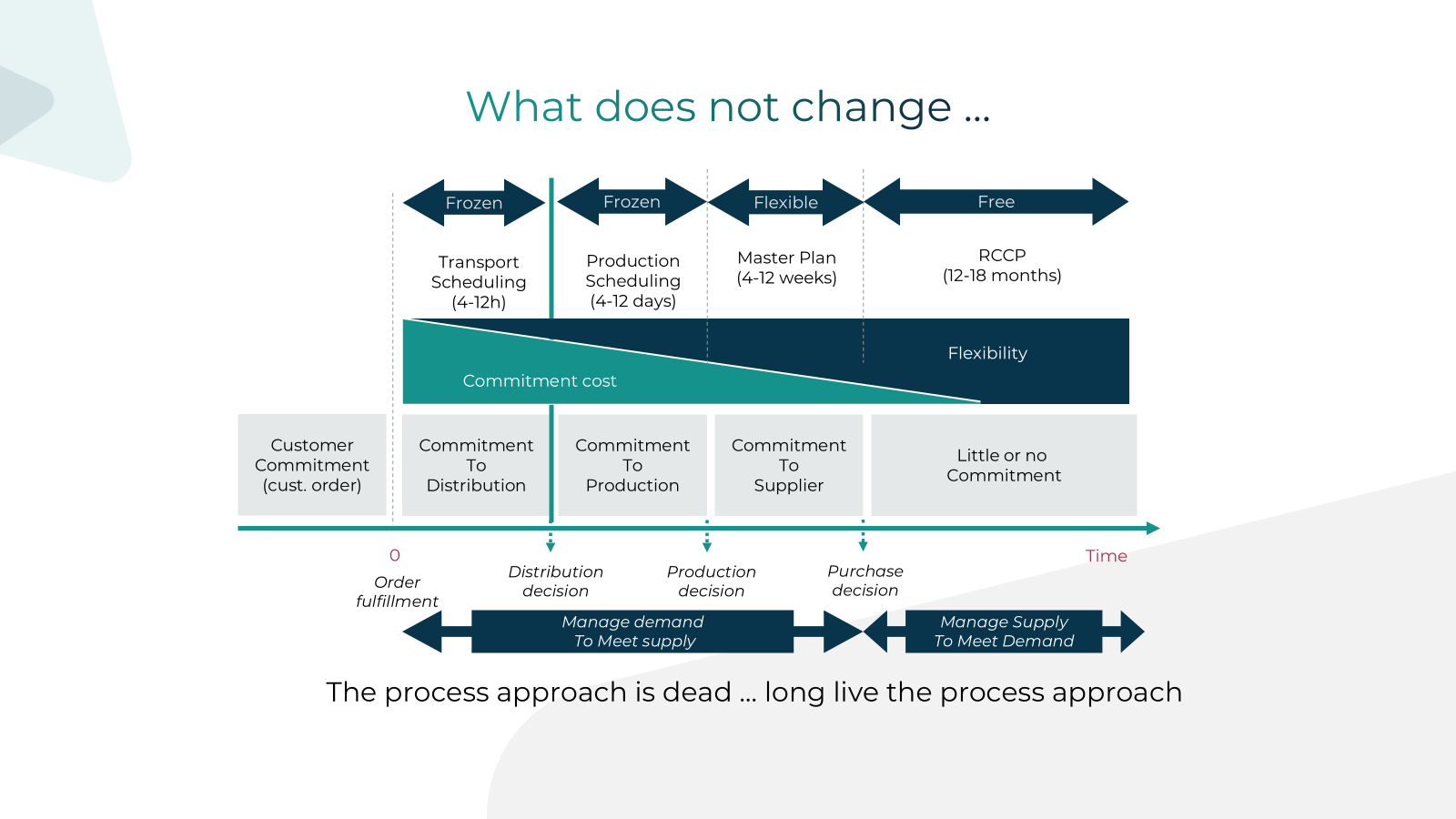
Second, faster scenario capabilities. Some vendors, like OMP, are explicitly moving toward what they call "decision-centric planning" – building the process around the decisions that matter, not around a rigid monthly cadence. Kinaxis has long championed concurrent planning, where a change on one side of the supply chain immediately surfaces the impact everywhere else. These aren't just marketing positions. They reflect a real need: the traditional process approach is too slow for the volatility we're living in.
Change to: That said, this does not mean abandoning existing supply chain processes. Capacity constraints are not resolved in a week, and raw material shortages typically require several weeks of master planning to work through. Different planning horizons still matter, as illustrated in the overview below. What does need to change is how quickly organizations can sense signals, run scenarios, and make decisions within those horizons.
Here's the uncomfortable truth: many APS and planning investment cases are failing not because the value isn't there, but because the business case isn't good enough.
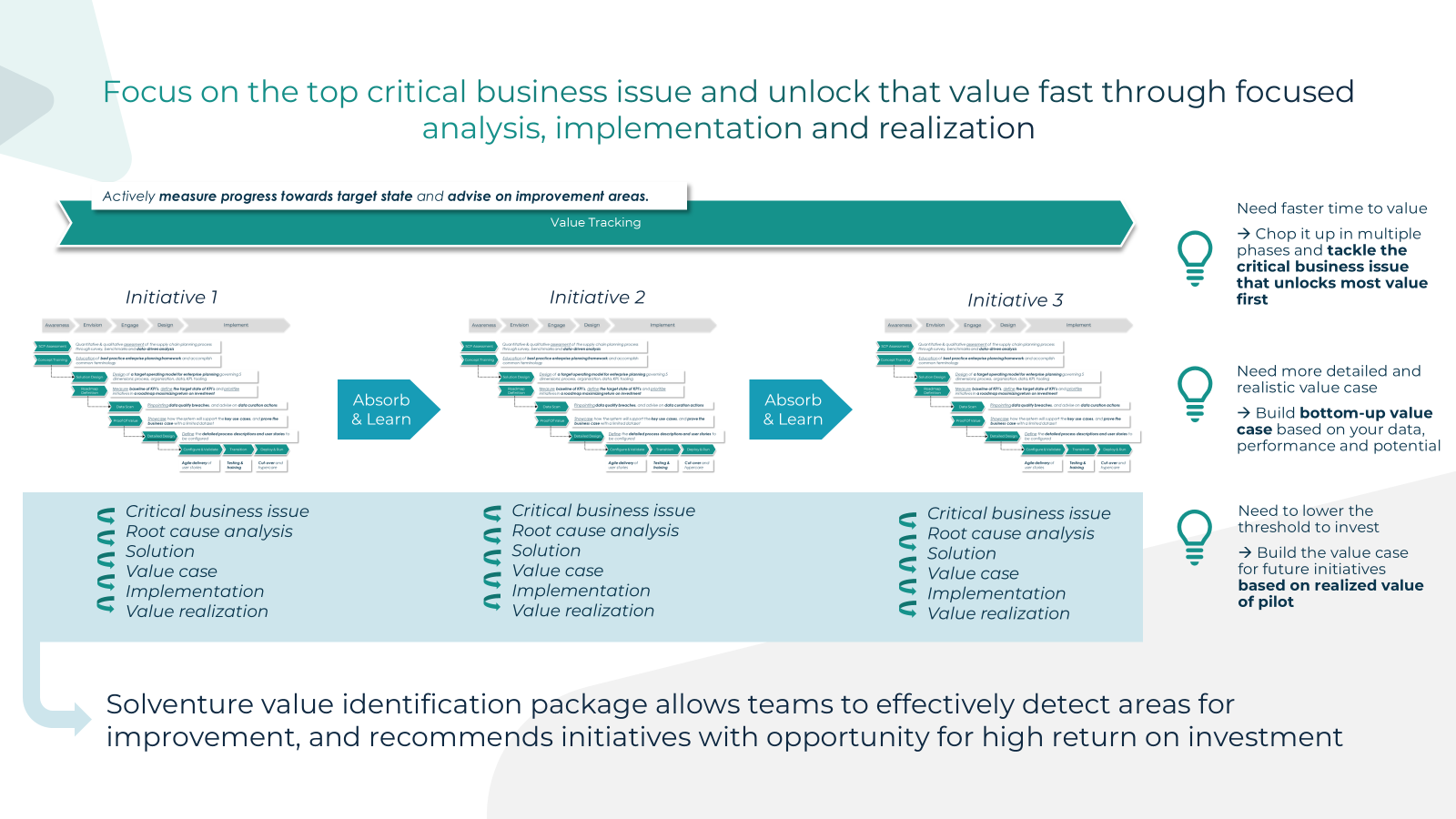
Too often, business cases rely on a high-level slide deck, a few industry benchmarks, a projected ROI that nobody really believes… Executive teams – especially now, with tighter budgets and more scrutiny – are no longer accepting that. They want to see the value in their data, not in a generic model.
What works? Three things:
At Solventure, we have adopted a value identification approach where we perform the analytical work upfront by scanning your data, benchmarking it against industry standards, and identifying the largest gaps, so that when we engage with an executive team, the case is specific, credible, and defensible.
It’s understandable that organizations are cautious. Large transformation programs feel risky when the business environment is already unstable. Yet it is precisely this instability that makes waiting the riskier option.
Making volume-based decisions without financial translation is improper management. Running Finance and Supply Chain on separate plans is a waste of resources and a source of decisions made on incomplete information. And building business cases on high-level assumptions is why planning investments keep getting deprioritized – not because the value isn't real, but because you're not proving it convincingly enough.
The companies that come out of this period ahead won't be the ones that waited for things to stabilize. They'll be the ones that upgraded their planning capabilities while others were standing still.
Many APS business cases rely on generic ROI assumptions and industry benchmarks. Executive teams increasingly expect a data-driven case built on measurable business value and company-specific opportunities.
The strongest APS business cases start with actual performance data, quantify improvement opportunities, and translate operational gains into financial impact.
Rising uncertainty, from tariffs to supply disruptions, requires organizations to evaluate multiple outcomes quickly and make informed decisions before risks materialize.
In our webinar, Delivering Results in Uncertain Times: From Business Case to Measurable APS Value, we explore how organizations can move from projected ROI to measurable impact.

The following resources may also be of interest to you: