
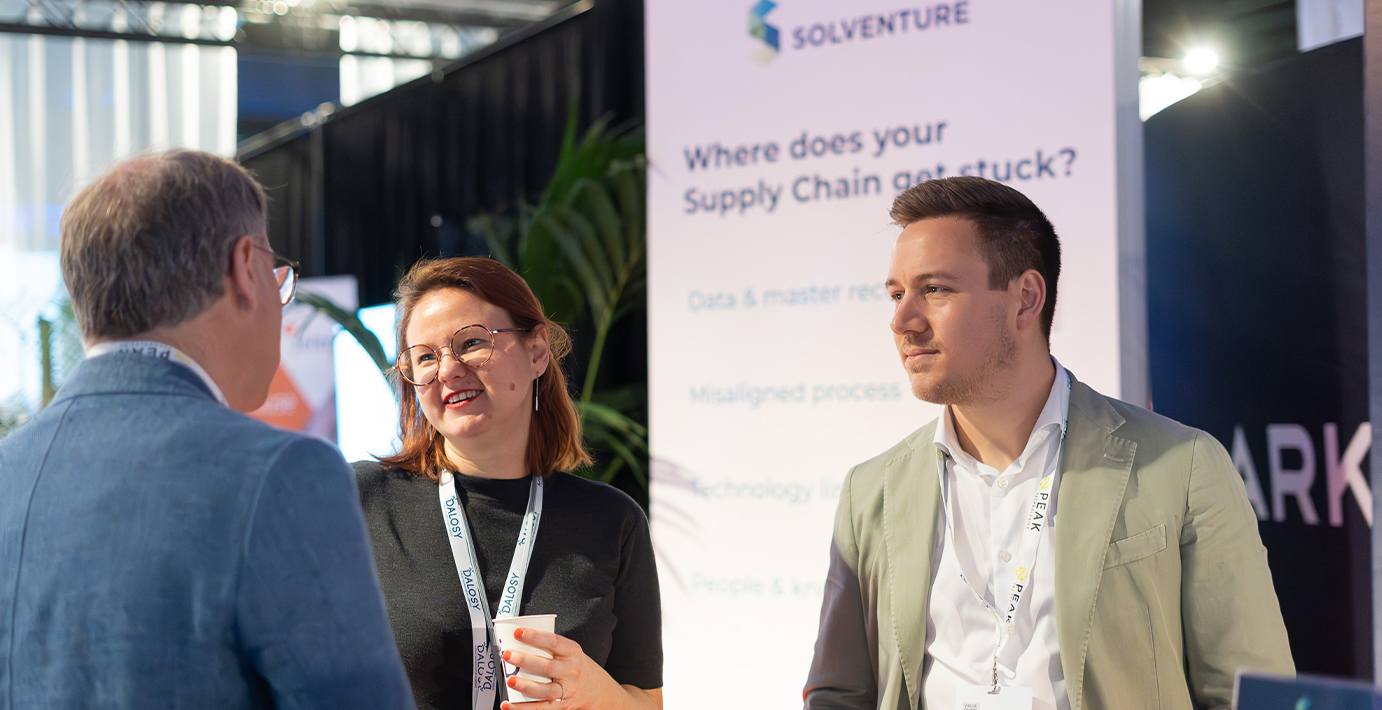
On March 19, 2026, Solventure joined Supply Chain Innovations (SCI) at Antwerp Expo, the leading Belgian knowledge and networking event for supply chain professionals. With more than 40 parallel seminars, 60+ solution partners and hundreds of practitioners coming together for a full day of inspiration, SCI 2026 confirmed its position as the place where theory, technology and real-life supply chain challenges meet.
As a long-standing contributor to the event, Solventure took part with a keynote by our CEO Bram Desmet and four in-depth customer cases. Across these sessions, one message clearly resonated: many organisations are still struggling with planning approaches that no longer fit today’s complex, fast-moving and risk-driven supply chain reality.
In his keynote, “The 3 Critical Gaps in S&OP & APS”, Bram Desmet challenged the audience to take a hard look at how demand and supply planning are still organised in most companies.
“We have been brainwashed,” Bram stated. “We took the theory for the truth. But maybe there’s a different way.”
Despite decades of experience with S&OP and APS, many organisations are still asking their planning tools the same basic questions they did 40 years ago, long before today’s volatility, interconnectedness and speed became the norm. The result? Processes that force early consensus, suppress valuable information, and fail to deal properly with risk, uncertainty and financial impact.
Bram argued that consensus demand at the start of the process is exactly what limits better decision-making. Sales, Supply Chain and Finance each look at demand through a different risk lens – optimistic, realistic or conservative and that diversity should be embraced rather than flattened.
A key alternative he proposed is layered demand and scenario-based supply planning, where different demand perspectives coexist and supply planning becomes automated, risk-aware and financially native. Instead of committing to one “perfect” number, organisations should explore multiple scenarios, assess service risk versus inventory risk, and make deliberate business choices aligned with strategy.
“If we want S&OP to become true business planning,” Bram concluded, “we need different tools, different processes, and a very different mindset.”
Throughout the day, several Solventure customers brought these ideas to life by sharing their own transformation journeys.
For SanoRice, Europe’s largest private-label producer of puffed rice cakes, years of strong growth brought new challenges. Demand started to exceed capacity, complexity increased, and existing planning processes were no longer sufficient to support the next growth phase.
Together with Solventure, SanoRice embarked on a structured improvement journey focused on demand and supply forecasting maturity, portfolio management and cross-plant coordination. By reassessing customer segmentation, aligning S&OP with service, cost and cash, and introducing more flexible, cost-informed planning, the company is laying the foundation for sustainable growth without sacrificing profitability.
As Bart Ruitenbeek, Senior Group Business Controller, summarised: “The key is making sure customers help solve the complexity they create and making sure our planning processes support that reality.”
Supply Chain Innovations 2026 made one thing abundantly clear: the future of supply chain performance will not be driven by better forecasts alone, but by better decisions – grounded in risk awareness, financial insight, cross-functional collaboration and continuous learning.
At Solventure, we strongly believe that rethinking planning processes, integrating finance and supply chain, and investing in people are essential steps to turn volatility into a strategic advantage.
We’d be happy to continue the conversation. If you prefer a call, you can book a meeting with an expert.

These Stories on S&OP