


AI is opening up new possibilities for Supply Chain Planning. But where can it really make a difference? Nick Verstraete, CTO at Solventure, explores what has changed, what becomes possible within and beyond existing planning systems, and why the real value lies in better planning decisions, not the technology itself.
When I talk to Supply Chain leaders at manufacturing companies, most tell me they have either not started with AI in Supply Chain Planning or are still exploring. Only a handful have a pilot running, and even fewer have something in production. At the same time, the pressure from the board to "do something with AI" is real. The result is a lot of activity, and surprisingly little impact on planning decisions.
In this blog, we explore how recent advances in AI are changing what's possible in Supply Chain Planning, both within and beyond APS systems, and how to identify and validate use cases with the potential to create business value.
The real innovation is not in ‘AI’ as a domain – it is in large language models (or LLMs for short). Artificial Intelligence (or ‘Super Intelligence’ as a certain president wants to name it) has always been a broad field: machine learning, heuristics, search algorithms, and the linear and mixed-integer optimization that APS systems like Arkieva, Kinaxis and OMP have been built on for decades. None of that is new.
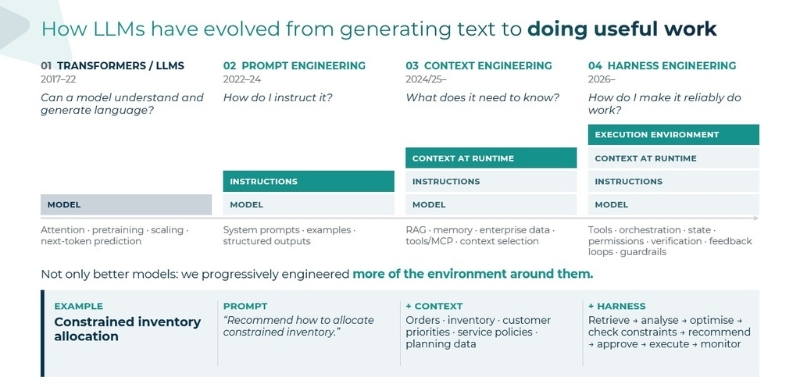
What changed is natural language models. Since the breakthroughs of 2017, these models can be trained on vastly more text, and today's LLMs can understand, reason, act and build in ways software never could. But let’s be clear about what they do: they generate text that fits the context you give them. That is why the evolution (see image below) went from:
Within Advanced Planning and Scheduling (or APS) systems, AI mainly improves planner productivity and effectiveness – and that has value, but it is not where the value stops. All major APS vendors are releasing or roadmapping Model Context Protocol (or MCP) connections, which let an LLM interact directly with the planning system. Here, I see three maturity steps:
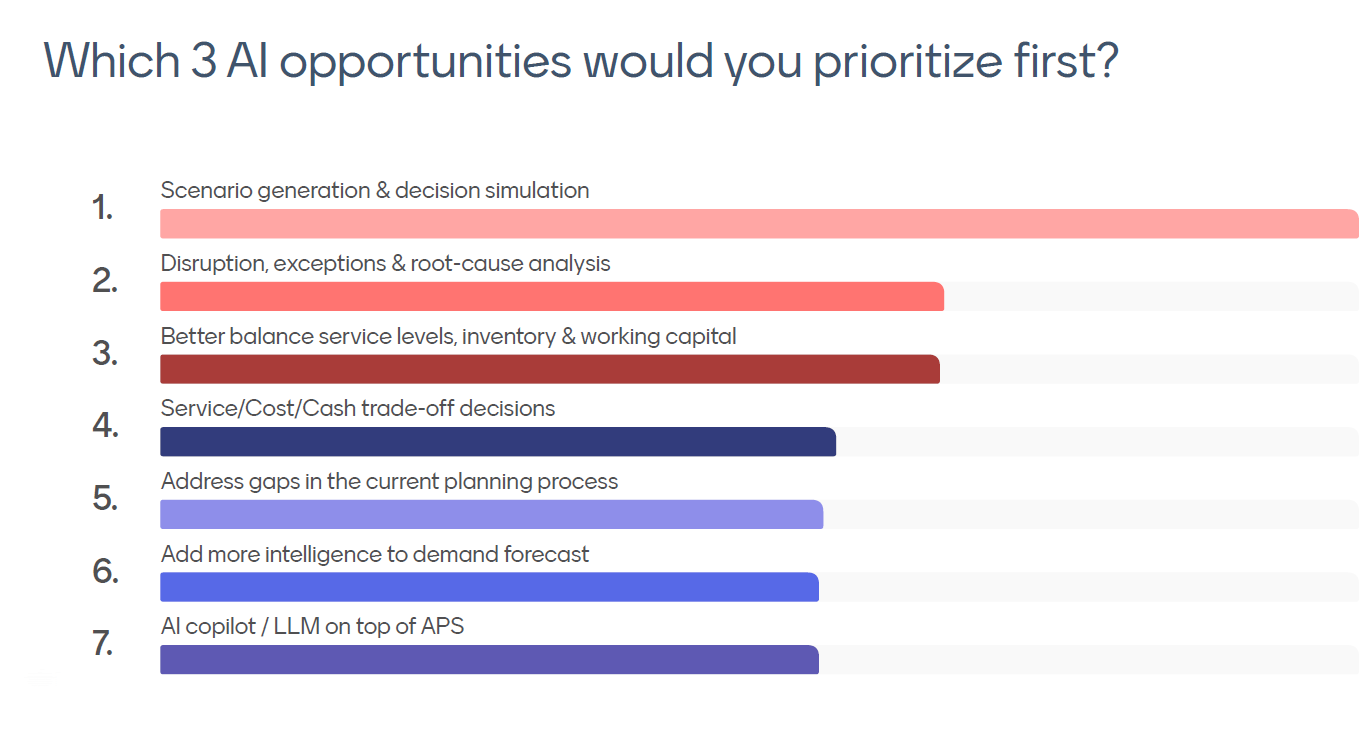
But which AI opportunities matter most to supply chain professionals? During the webinar: AI in Supply Chain Planning: What’s Changing and What Really Matters? we asked participants which AI opportunities they would prioritize in supply chain planning.
Scenario generation and decision simulation emerged as the clear top priority, followed by disruption, exceptions and root cause analysis, and balancing service levels, inventory and working capital.
The bigger opportunity lies in broadening the Supply Chain decision context. Instead of keeping Supply Chain planning and Finance planning in separate silos, you can build decision support that spans APS, ERP and FP&A data together.
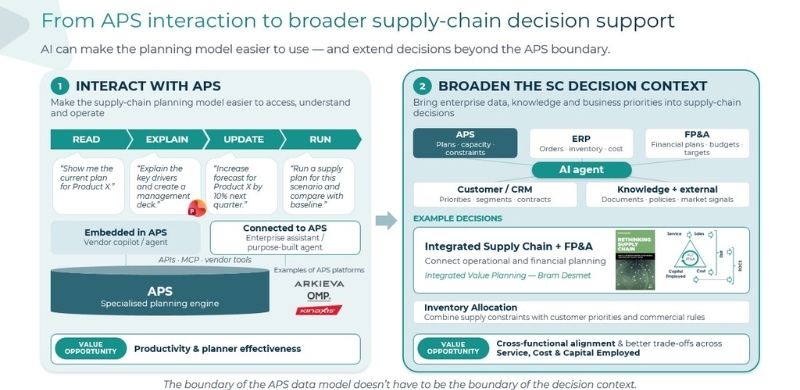
As my colleague Bram Desmet describes in his book Rethinking Supply Chain, Integrated Value Planning means moving beyond planning Supply Chain and Finance separately. It is about making more integrated decisions across the Supply Chain Triangle, balancing service, cost and capital employed.
AI makes those cross-functional use cases practical: detecting disruptions and translating them into supply planning exceptions, balancing service levels against inventory and working capital, or supporting service-cost-cash trade-off decisions in your S&OP or IBP cycle. The value is in better trade-offs, not faster spreadsheets.
If you want good results from LLMs and agents, the quality of the context you give them is everything and that context is still mostly implicit. When I ask companies what is stopping them, the answers are consistent: data availability, data quality, fragmentation, skills and executive commitment.
What does ‘available inventory’ mean in your company? What is your definition of service level, of capacity, of margin? Which make-to-order and make-to-stock policies apply? Today these definitions live in planners' heads.
For AI they need to be explicit and centralized: a clear planning data model, a semantic layer, and documented decision logic on your enterprise data platform, whether that is Azure, Databricks, Snowflake or Palantir Foundry. You don't need a supply chain knowledge graph on day one. You do need to understand the layers and build them out gradually.
AI prototyping brings validation forward. In Solventure's 7-step transformation methodology, the envision, engage and design phases used to mean analysis, requirements and blueprints. Now, instead of only talking about requirements, we build a prototype and validate three things fast: does it solve the problem, will planners adopt it, and does it create bottom-line value. Only then do you take the industrialization decision – a production pilot, or a sharper definition of what the APS needs to cover.
This is made possible by a new type of role: the forward deployed engineer, combining Supply Chain planning expertise, data & cloud skills, AI engineering and classic data science. Forecasting algorithms and safety stock calculations are not replaced by LLMs – they remain essential.
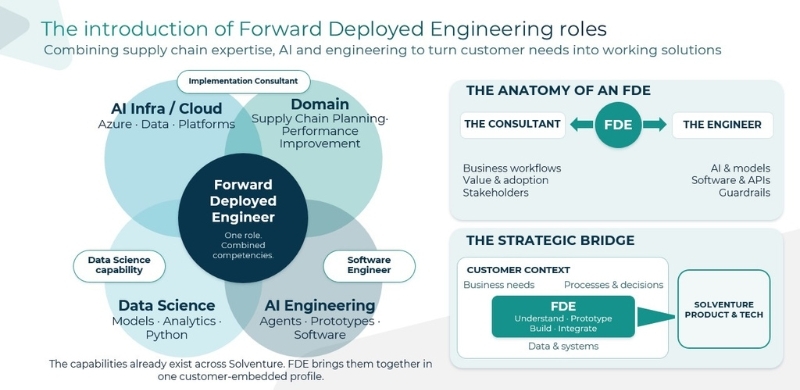
A recent example: in two months, one of our forward deployed engineers worked alongside a customer's planning team to develop a prototype combining rough-cut capacity planning, demand sensing and shift-based operator staffing with a small optimization engine.
One engineer, one planning team, and several fast iterations to explore an alternative to an Excel-based planning process.
AI is still software. It is fundamentally more capable software, but the hype should not overtake that fact. Start from high-value decisions, augment your existing enterprise technology rather than replace it, and look for value in better trade-offs between service, cost and capital employed.
The goal is not to predict every AI use case. It is continuous discovery: list the planning decisions your organization is poorly supported in, estimate the value at stake, and only then explore solutions. AI changes what planning software can do. But the real value still comes from improving the planning decision.
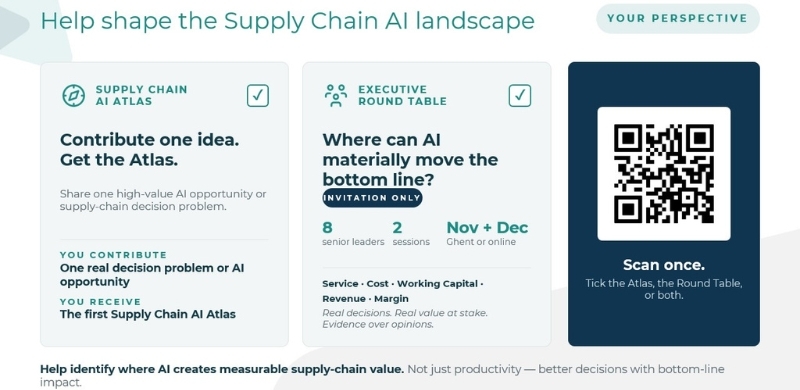
We're developing a Supply Chain AI Atlas to explore practical AI use cases across the planning domain. We're also bringing supply chain leaders together in Executive AI Roundtables to exchange perspectives on opportunities, challenges and real-world applications.
Interested in contributing to the AI Atlas or joining a roundtable?

AI is expanding what software can do, both within and beyond existing planning systems. Recent advances in large language models (LLMs), combined with better access to business data and context, are creating new possibilities for planning applications and decision support. This includes faster scenario generation, more tailored applications and better support for decisions across business functions.
AI is not about replacing existing planning systems, but augmenting their capabilities. Within APS, AI can help planners retrieve information, update forecasts, generate reports and create and evaluate scenarios. Beyond APS, AI can connect information from ERP, planning and financial systems to support broader, cross-functional decisions.
AI can improve planner productivity, but the opportunity goes beyond efficiency gains. Greater value can come from improving planning decisions and supporting better trade-offs between service, cost and capital employed. The key is to start with high-value business decisions rather than looking for opportunities to apply AI technology.
AI needs more than access to data. It also needs the business context behind that data, including definitions of inventory, capacity, service levels, customer priorities and decision rules. Making this knowledge explicit through planning data models, semantic layers and decision logic helps AI applications generate more relevant and useful outputs.
Start by identifying where value is being lost in your current planning processes and which decisions are not adequately supported. Prioritize the problems with the greatest potential business impact before exploring possible AI solutions. Rapid prototyping can then help validate whether an application addresses the problem, supports user adoption and delivers the intended business value before moving towards implementation.